
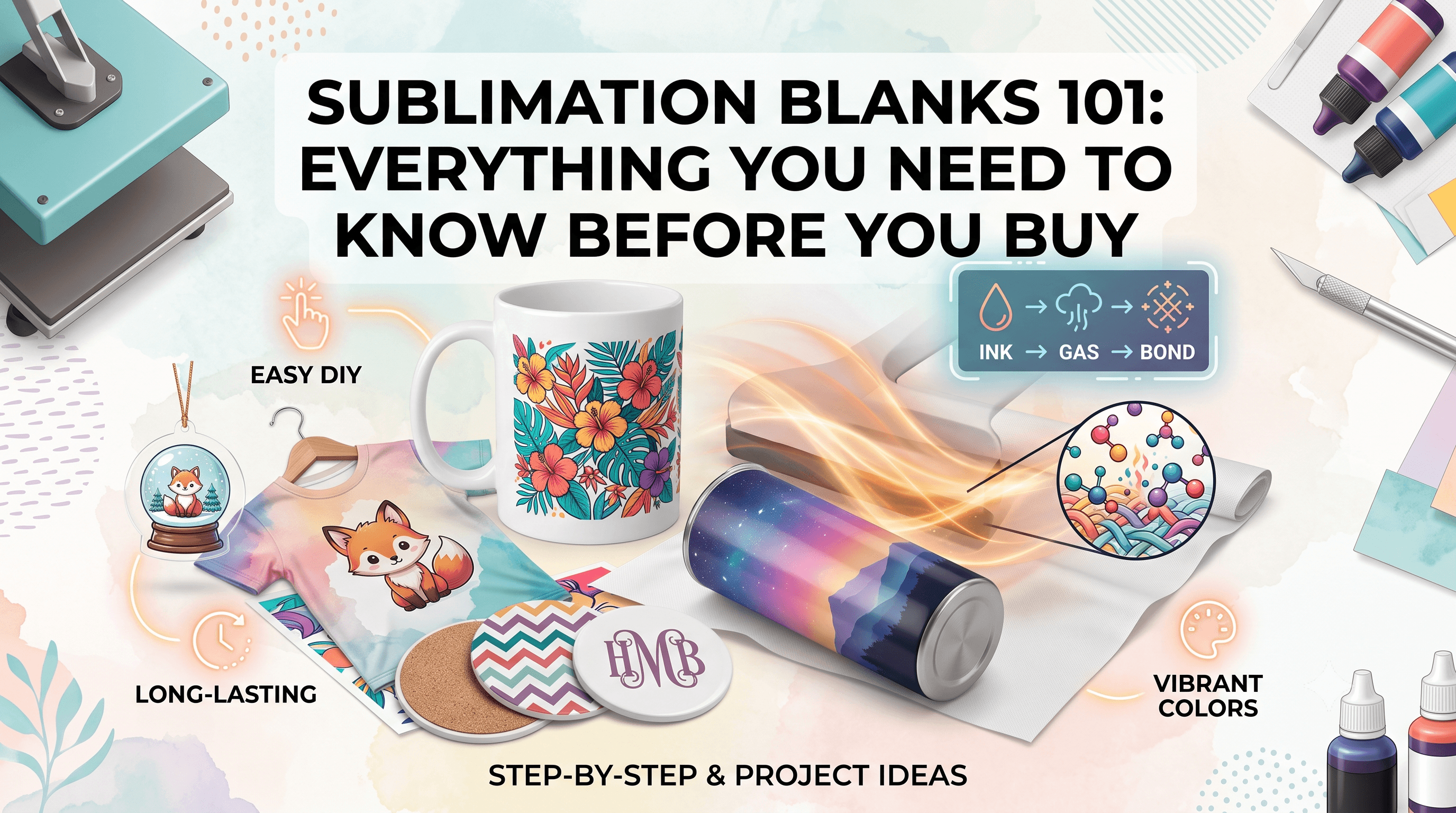
Sublimation Blanks 101: Everything You Need to Know Before You Buy
Type "sublimation blanks" into a search bar and within seconds you're drowning in options: mugs, tumblers, ornaments, coasters, puzzle pieces, dozens of suppliers, each claiming theirs is the best. None of the listings tell you which ones are actually worth your money.
The gap between a blank that holds color for years and one that fades in a month comes down to a few things listings never mention. This post covers what makes a blank good, the best options by project type, whether sublimation can be combined with paint or vinyl, and whether making your own blanks is realistic.
What Actually Makes Something a Sublimation Blank
A sublimation blank is any item that can accept sublimation ink permanently, and that comes down to one of two things: high polyester content (for fabric) or a polymer coating, a thin layer added to hard surfaces like mugs, tumblers, and ornaments that lets ink particles bond to the surface under heat. Without one of these two things, sublimation ink either won't transfer at all or will fade fast and wash out after a few uses.
Blank quality matters before you spend money on ink and press time, because no amount of skill fixes a blank that wasn't built to hold the print.
What to Check Before You Buy Sublimation Blanks
Once you know what makes something a sublimation blank in the first place, the real skill is knowing what to check before you click "buy." Here's what to look for, after enough disappointing orders to make it a habit.
- Reviews that mention coating quality, not just shipping speed or packaging. A five-star review about a fast box tells you nothing about whether the coating holds a print.
- Polyester percentage, if you're buying fabric blanks. "Poly blend" without a number is hiding something, and it's usually lower than you'd want.
- Finished, sublimated sample photos in the listing, not just photos of the blank sitting empty. A blank that looks great unprinted can still produce flat, dull results once pressed.
- Whether the supplier specializes in sublimation printing blanks, or just carries them alongside fifty unrelated categories. Specialists tend to test their coatings; general suppliers often don't.
- A small test order before bulk. This habit will save you more money than anything else here. Order a handful of blanks before five hundred, especially from a new supplier.
Always request or search for sublimated sample photos before ordering in bulk — an empty blank photo tells you nothing about print quality.
Best Sublimation Blanks by Project Type
Drinkware: Straight-walled tumblers press more evenly than tapered ones, which makes them more forgiving for beginners still learning wrap tension. Ceramic mugs with a glossy, even coating produce the most vibrant results, and these tend to be the best sublimation blanks for anyone just starting out.
Apparel: 100% polyester shirts give the most saturated color, full stop. Poly blends under 65% will look noticeably washed out by comparison.
Gifts and home decor: Coated ornaments, slate or hardboard coasters, and acrylic keychains are reliable, beginner-friendly choices. They're flat, forgiving to press, and widely available, which makes them a safe category for testing a new supplier's coating quality.
Signs and larger pieces: Coated aluminum or hardboard sheets work well for wall art and signage, though they require a larger press or oven setup. If you're shopping for the best sublimation blanks for a bigger project, factor the equipment cost in before you fall for a great-looking sheet.
Sublimation Blanks Ideas Beyond the Usual Mug
Once you're comfortable with mugs and tumblers, here are a few sublimation blanks ideas worth trying when you want to branch out.
- Sublimated puzzle pieces make an unusual, personal gift, especially using photos or kids' artwork.
- Mouse pads are an easy way to print a custom design for a desk setup.
- Phone cases are a quick, popular item for small businesses since they're cheap to stock.
- Cutting boards with sublimation coating make a practical kitchen gift that doesn't feel like a novelty item.
- License plate covers and car coasters reach a customer base that mugs and shirts don't always cover.
- Dog tags or pet ID blanks are a low-cost way to test a new niche.
Can You Combine Sublimation Blanks With Paint or Vinyl?
These two questions come up constantly, so here are straight answers to both.
Can you paint on sublimation blanks?
Yes. Acrylic paint can be added after sublimation on most hard blanks, typically for small accent details rather than covering the whole design. The order matters: sublimate first, paint after. Paint applied before sublimating interferes with the ink's ability to bond with the coating, which usually means a patchy, half-transferred result.
Can you use vinyl on sublimation blanks?
Yes, and this is where a lot of personalization happens. Both heat transfer vinyl and adhesive vinyl can be layered on top of a sublimated design once it has cooled completely. This combination is common for adding white text or accents on darker sublimated backgrounds, since sublimation ink struggles to show up on dark bases and vinyl doesn't have that limitation.
Always let a sublimated design cool completely before layering vinyl on top, and never paint before sublimating — it will interfere with ink bonding and cause a patchy transfer.
Pairing cut vinyl accents with a sublimated tumbler base has become a popular personalization technique on its own; if you want to go deeper on layering the two, vinyl tumbler application techniques are worth reading before you try it.
Cricut Sublimation Blanks: What Actually Works
If you came to sublimation through Cricut, you've probably run into Infusible Ink and wondered how it relates to everything else. Infusible Ink works on the same principle as traditional sublimation, just using pre-printed transfer sheets and pens instead of a separate printer. Any blank labeled sublimation-compatible will generally work with Infusible Ink too, since both rely on the same coating or polyester requirement.
There's one practical difference worth knowing before you buy Cricut sublimation blanks for the Mug Press specifically: it's sized for particular mug shapes, so not every sublimation mug blank will fit it. Checking size compatibility before you buy saves you from a mug that looks perfect but won't close the press properly. If you haven't gone through it yet, the full Mug Press and Infusible Ink workflow is worth a read before your first order.
Making Your Own Sublimation Blanks: Is It Worth It?
At some point, almost everyone doing this asks how to make sublimation blanks instead of buying them pre-coated. The basic idea is simple: specialty sublimation coating sprays can be applied to certain untreated surfaces, like plain ceramic or untreated wood, to make them sublimation-capable.
Here's the honest part. DIY coating sprays usually produce less even, less vibrant results than factory-coated blanks, and getting consistent coverage takes practice. Your first several attempts will probably have streaks or spots where the ink doesn't take. If you're trying to make your own sublimation blanks purely to save money on something common like mugs or tumblers, it's usually not worth it. Pre-coated blanks for those items are cheap enough that the time spent learning to spray evenly costs more than the money saved.
Once your blanks are sorted, if a design file gives you trouble uploading to Design Space or Silhouette Studio, our AI SVG tool can fix pattern fills, clipping paths, and other common SVG errors in seconds, so the only thing left to worry about is the press.
Where learning how to make your own sublimation blanks actually pays off is when you need something specific that isn't sold pre-coated anywhere: an unusual shape, a material nobody manufactures as a blank, something custom enough that no supplier carries it. In that narrow case, it's less a cost-saving measure and more the only way to get what you need.
Estimate Your Project Costs
Trying to figure out whether a batch of blanks is worth ordering? Use our free calculator to estimate material costs before you buy:
Not every item labeled "sublimation" is actually good quality, and the gap between a great blank and a wasted one usually shows up after you've pressed it. A few minutes checking reviews, coating details, and sample photos before buying sublimation blanks saves you from tossing out faded mugs and washed-out shirts later. Start small with a supplier you trust, test a handful of blanks before bulk ordering, and widen your product range once you know their coating holds up.